

Bank Reconciliation - A Complete Guide for Businesses
Bank reconciliation is the process of comparing a company’s bank statement with its internal accounting records to make sure both records match. It helps businesses confirm that payments, deposits, invoices, expenses, bank charges, refunds, transfers, and other transactions are recorded correctly.
In simple words, bank reconciliation answers one important question:
Does the money shown in the bank match the money recorded in the accounting system?
If the answer is yes, the business can trust its cash records. If the answer is no, the finance team needs to find the difference, understand the reason, and correct the records.
Bank reconciliation is one of the most important finance tasks for businesses, accountants, and finance teams. It helps maintain accurate cash flow, clean accounting records, better reporting, and stronger financial control.
Without proper bank reconciliation, a business may think it has more or less money than it actually has. This can lead to poor decisions, missed payments, incorrect reports, tax confusion, and problems during audits.

What is bank reconciliation?
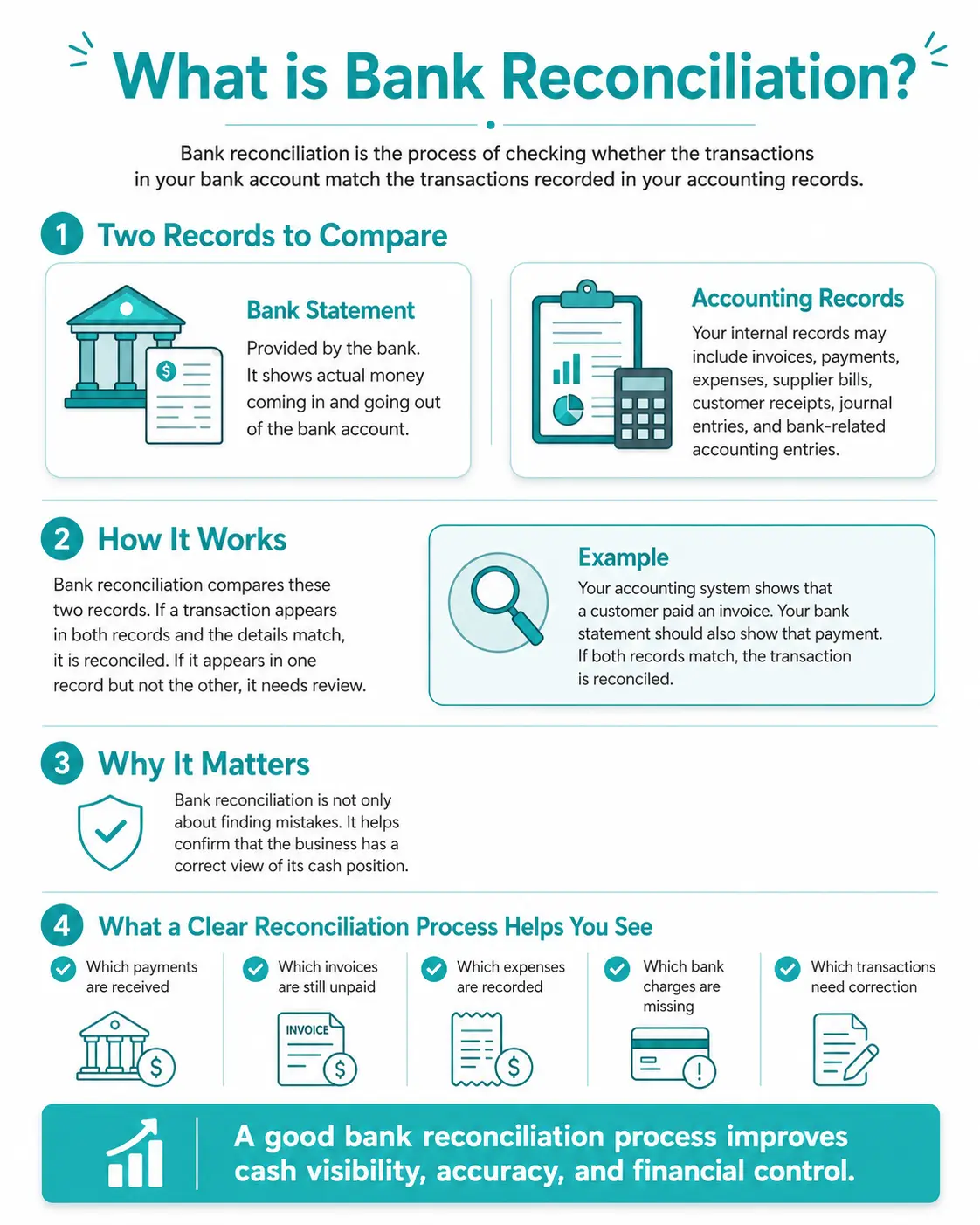
Bank reconciliation is the process of checking whether the transactions in your bank account match the transactions recorded in your accounting records.
A business usually has two records of money movement. The first record is the bank statement, which is provided by the bank. It shows actual money coming in and going out of the bank account. The second record is the internal accounting record, which may include invoices, payments, expenses, supplier bills, customer receipts, journal entries, and bank-related accounting entries.
For example, your accounting system may show that a customer paid an invoice. Your bank statement should also show that payment. If both records match, the transaction is reconciled. If the payment appears in one record but not the other, it needs review.
Bank reconciliation is not only about finding mistakes. It also helps confirm that the business has a correct view of cash position. A clear bank reconciliation process helps businesses know which payments are received, which invoices are still unpaid, which expenses are recorded, which bank charges are missing, and which transactions need correction.
Bank Reconciliation Meaning in Simple Words
The meaning of bank reconciliation is simple. It means matching your bank records with your accounting records. Think of it like checking two lists. One list comes from the bank. The other list comes from your accounting system. Both should show the same financial activity.
If a customer pays €1,000 into your bank account, that payment should also be recorded in your accounting system. If your company pays €300 to a supplier, that payment should appear in both the bank statement and accounting records.
When both sides match, your finance records are more reliable. If they do not match, the difference may come from timing issues, missing entries, bank fees, duplicate records, payment delays, wrong amounts, or manual mistakes. Bank reconciliation helps identify and fix these differences.
Why is bank reconciliation important?
Bank reconciliation is important because it protects the accuracy of business finance. A company cannot make good financial decisions if its cash records are wrong. If bank transactions are not matched with accounting records, reports may show incorrect balances, unpaid invoices may be missed, and expenses may not be recorded properly.
Bank reconciliation helps businesses maintain financial clarity. It supports:
- Accurate cash balance.
- Better cash flow control.
- Cleaner accounting records.
- Correct invoice payment status.
- Supplier payment tracking.
- Expense verification.
- Fraud or error detection.
- Tax and audit preparation.
- Reliable financial reporting.
For example, if a business does not reconcile its bank account, it may think a customer invoice is unpaid when the payment was already received. Or it may think a supplier bill was paid when the bank transaction did not actually happen.
These mistakes affect reporting, customer follow-up, supplier relationships, and business decisions. Bank reconciliation gives finance teams a clear way to verify real money movement.

How does bank reconciliation work?
Bank reconciliation works by comparing transactions from the bank statement with transactions in the accounting system. The process can be manual, semi-automated, or fully supported by accounting software.
A basic bank reconciliation process looks like this:
Bank statement is reviewed → Accounting records are checked → Transactions are matched → Differences are investigated → Records are corrected → Reconciliation is completed
Step 1: Collect the bank statement
The finance team starts with the bank statement for a specific period, such as a week, month, or quarter. The bank statement includes deposits, withdrawals, card payments, bank fees, transfers, refunds, interest, and other bank movements.
Step 2: Review accounting records
The team then reviews the internal accounting records for the same period. These records may include invoices, customer payments, supplier payments, expenses, payroll-related payments, tax payments, bank transfers, and journal entries.
Step 3: Match transactions
Each bank transaction is matched with the correct accounting record. For example, a customer payment in the bank should match a customer invoice payment in the accounting system. A supplier payment in the bank should match the supplier bill or expense record.
Step 4: Identify differences
If a transaction does not match, the finance team investigates the reason. The difference may be caused by bank fees, delayed deposits, missing accounting entries, duplicate records, wrong amounts, or transactions recorded in the wrong period.
Step 5: Correct records
Once the issue is found, the team updates the accounting records if needed. This may include adding missing bank fees, correcting payment amounts, recording expenses, adjusting invoice status, or removing duplicate entries.
Step 6: Finalize reconciliation
After all transactions are matched or explained, the reconciliation is complete. This gives the business a more accurate cash position and cleaner accounting records.
Bank Reconciliation Example
A business sends an invoice of €2,000 to a customer. The accounting system records the invoice as unpaid. A few days later, the customer pays €2,000 by bank transfer.
The bank statement now shows a deposit of €2,000. During bank reconciliation, the finance team matches the €2,000 bank deposit with the customer invoice. Once matched, the invoice status can be updated from unpaid to paid.
This is a simple matched transaction. Now imagine another case. The bank statement shows a bank fee of €15, but the accounting records do not show this fee. During reconciliation, the finance team identifies the missing fee and records it as a bank charge expense. This makes the accounting records more accurate.
Another example is a duplicate payment. If a supplier payment appears twice in the accounting system but only once in the bank statement, reconciliation helps identify the duplicate entry. This is why bank reconciliation is important. It helps businesses catch real differences before they become larger financial problems.
What is a bank reconciliation statement?
A bank reconciliation statement is a document or report that explains the difference between the bank statement balance and the accounting record balance. Sometimes the bank balance and accounting balance may not match immediately because of timing differences.
For example, a business may record a customer payment today, but the bank may process it the next day. Or the bank may charge a fee that has not yet been recorded in accounting. A bank reconciliation statement helps explain these differences.
It may include:
- Bank statement balance.
- Accounting book balance.
- Deposits in transit.
- Outstanding payments.
- Bank fees.
- Interest.
- Errors or corrections.
- Adjusted balance.
The goal is to show why the balances are different and how they can be matched. A clear reconciliation statement helps accountants, finance teams, auditors, and business owners understand the real cash position.

Common Bank Reconciliation Problems
Many businesses struggle with bank reconciliation because their financial data is scattered. The most common problems include missing transactions, wrong amounts, duplicate entries, delayed payments, unrecorded bank fees, unclear invoice references, customer payments without proper details, supplier payments without matching bills, and manual spreadsheet errors.
One common issue is that payments appear in the bank statement but are not recorded in the accounting system. This can happen when the finance team forgets to update payment status or when the payment is received before the invoice is reviewed.
Another common problem is bank fees. Banks may deduct small charges, but if the accounting team does not record them, the bank balance and accounting balance will not match. Duplicate records are also common. A payment may be entered manually and then imported again from the bank statement, creating two records for the same transaction.
Unclear payment references can also slow down reconciliation. If a customer sends a payment without invoice number or client name, the finance team may need to spend extra time identifying the correct invoice.
Bilansys helps reduce these problems by connecting bank transactions with invoices, payments, expenses, accounting records, documents, and reports.
Cloud Accounting VS Offline Accounting
Bank reconciliation can be done manually or with automation. Manual bank reconciliation usually means downloading bank statements, opening spreadsheets, checking accounting records, and matching transactions one by one.
This may work for a very small business with few transactions. But as transaction volume grows, manual reconciliation becomes slow and risky. Automated bank reconciliation uses software to help match bank transactions with accounting records.
The system can suggest matches based on amount, date, customer, supplier, invoice number, payment reference, and transaction type.
| Area | Manual Bank Reconciliation | Automated Bank Reconciliation |
|---|---|---|
| Transaction matching | Done by hand | Suggested by software |
| Time required | High | Lower |
| Error risk | Higher | Lower with review |
| Duplicate detection | Manual | Easier to identify |
| Payment status updates | Manual | Can be connected |
| Reporting | Delayed | Faster visibility |
| Scalability | Difficult | Better for growing businesses |
| Review | Time-consuming | More focused on exceptions |
Automation does not remove the need for finance review. It reduces repetitive matching work so accountants and finance teams can focus on exceptions, corrections, and financial control.
What is AI bank reconciliation?
AI bank reconciliation uses artificial intelligence to help match bank transactions with accounting records more intelligently. Traditional matching may depend mostly on exact amounts, dates, or references. AI-assisted reconciliation can help identify possible matches even when information is incomplete or slightly different.
For example, a customer payment may not include the invoice number, but AI can help suggest a possible match based on customer name, payment amount, date, and previous payment behavior.
AI can also help detect unusual transactions, possible duplicates, missing records, or mismatched amounts. AI bank reconciliation can support:
- Invoice and payment matching.
- Bank movement association.
- Expense categorization.
- Duplicate detection.
- Error detection.
- Payment status updates.
- Financial alerts.
AI does not replace accountants or finance teams. It helps them work faster by reducing repetitive review and highlighting transactions that need attention.
Bilansys uses AI automation to support invoice matching, bank movement association, error detection, and financial alerts, helping businesses manage reconciliation with better speed and control.


Why bank reconciliation matters for cash flow?
Cash flow is the movement of money in and out of a business. Bank reconciliation is important for cash flow because it confirms what money has actually entered or left the bank account.
A business may issue many invoices, but cash flow depends on whether customers actually pay. A business may record supplier payments, but the bank account must confirm the money has left. Without reconciliation, cash flow reports may be inaccurate.
For example, if an invoice is marked as paid in accounting but the bank does not show the payment, the business may overestimate available cash. If a payment is received but not recorded, the business may continue chasing a customer unnecessarily. Bank reconciliation helps keep cash flow real.
It helps businesses understand:
- Which payments were received.
- Which invoices are still unpaid.
- Which supplier payments cleared.
- Which bank fees were charged.
- Which transactions need review.
- How much cash is actually available.
This gives business owners and finance teams better control over financial decisions.
Bank Reconciliation and Accounting Accuracy
Accounting records must reflect real financial activity. Bank reconciliation helps confirm that accounting entries match actual bank movements. If a transaction appears in the bank but not in accounting, the accounting record is incomplete. If a transaction appears in accounting but not in the bank, the finance team needs to check whether it is pending, incorrect, duplicated, or recorded too early.
This is especially important for month-end and year-end closing. Clean reconciliation helps prepare accurate financial statements, including profit and loss reports, balance sheets, and cash flow reports.
Bilansys connects bank reconciliation with accounting records so businesses can maintain cleaner financial data and reduce manual correction work.


Bank Reconciliation and Invoices
Invoices are directly connected with reconciliation. When a customer pays an invoice, that payment should be matched with the invoice record. This confirms that the invoice is paid. If payments are not matched properly, the business may have wrong customer balances. Some invoices may appear unpaid even after payment.
Other invoices may be marked paid incorrectly. Bank reconciliation helps connect customer payments with invoices. For supplier invoices, reconciliation confirms that payments have actually been made. This helps avoid duplicate payments, missed supplier bills, and unclear payable records.
Bilansys helps connect bank movements with invoice records, payment status, customer balances, supplier balances, and accounting entries.
Bank Reconciliation and Expenses
Expenses also need to match bank transactions. A business may pay for subscriptions, office rent, utilities, software tools, travel, supplies, bank charges, taxes, and other operating costs.
If these payments appear in the bank account but are not recorded in accounting, expenses may be understated. This can make profit look higher than it really is. Bank reconciliation helps ensure expenses are recorded correctly. It also helps finance teams categorize expenses properly and connect supporting documents such as receipts, supplier invoices, and contracts.
Bilansys helps connect expenses with bank movements, documents, accounting records, and reports so finance teams can review costs with more confidence.


Bank Reconciliation and Reporting
Financial reports depend on clean accounting data. If bank transactions are not reconciled, reports may be wrong. A profit and loss report may miss expenses. A cash flow report may show incorrect cash movement. A balance sheet may show wrong bank balances.
Bank reconciliation improves reporting because it confirms that bank-related accounting records are accurate. This helps businesses prepare more reliable reports for owners, managers, accountants, tax consultants, and auditors.
Bilansys connects reconciliation with reporting and analytics so businesses can use cleaner data for financial decision-making.
Bank Reconciliation and Audit Readiness
Auditors and tax reviewers often need proof that financial records are accurate. Bank reconciliation supports audit readiness because it creates a clear link between bank statements and accounting records.
If a business can show that bank transactions match invoices, expenses, payments, and accounting entries, the financial records become easier to review. Poor reconciliation can create audit problems. Missing transactions, unexplained differences, duplicate payments, and unclear records can make audits longer and more stressful.
Bilansys helps businesses organize bank reconciliation records, documents, payment proofs, invoices, and reports so teams can prepare for review with less confusion.


How often should businesses reconcile bank accounts?
The frequency of bank reconciliation depends on business size, transaction volume, and financial risk. Small businesses may reconcile monthly. Businesses with high transaction volume may reconcile weekly or daily. Companies with many customer payments, supplier payments, or multiple bank accounts should reconcile more often.
A monthly reconciliation may be enough for a small business with limited activity. But for finance teams managing large volumes, waiting until month-end can create too much work. More frequent reconciliation helps catch problems earlier.
For example, if a duplicate payment happens today, weekly reconciliation can find it quickly. If the business waits until month-end, the issue may be harder to trace.
Bilansys helps businesses manage reconciliation more efficiently by connecting bank movements with invoices, payments, accounting entries, and AI automation.
Who needs bank reconciliation?
Bank reconciliation is useful for every business that has bank transactions. Small businesses need it to confirm cash, track payments, and avoid mistakes. SMEs need it to manage growing transaction volume. Finance teams need it for reporting, cash flow, and month-end close. Accountants need it to prepare clean records for clients. Enterprises need it to manage multiple bank accounts, companies, branches, and entities.
It is especially useful for businesses that handle:
- Customer invoices.
- Supplier payments.
- Online payments.
- Recurring expenses.
- Bank transfers.
- Multiple accounts.
- Tax payments.
- Cash flow reports.
- Audit preparation.
If money moves through a bank account, reconciliation is necessary.

What to look for in bank reconciliation software?
When choosing bank reconciliation software, businesses should look for more than simple transaction matching. A good system should help connect bank transactions with invoices, payments, expenses, documents, accounting entries, and reports.
Important features include transaction matching, invoice payment matching, expense categorization, duplicate detection, missing transaction alerts, bank fee recording, payment status updates, document attachments, reporting dashboards, user permissions, and audit history.
AI automation is also useful because it can suggest matches and highlight unusual transactions. For businesses that want better financial control, reconciliation should not be isolated. It should connect with accounting, invoicing, reporting, tax compliance, and document management. Bilansys is built for this connected approach.

How does Bilansys help with bank reconciliation?
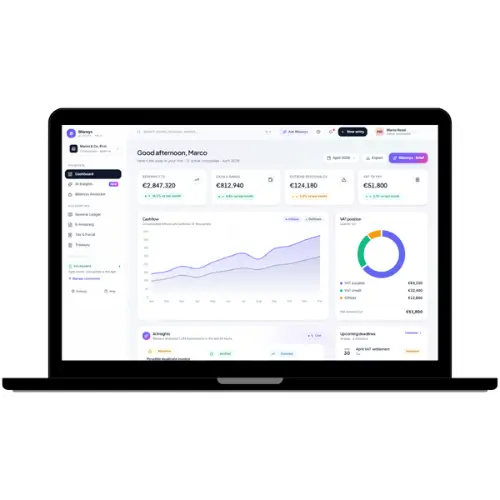
Bilansys helps businesses, accountants, and finance teams manage bank reconciliation with more structure and control. With Bilansys, teams can connect bank transactions with invoices, payments, expenses, accounting records, customer balances, supplier balances, documents, reports, and AI automation.
Bilansys helps users reduce manual matching, identify missing records, track invoice payments, connect expenses with bank movements, and improve cash flow visibility.
This is useful because reconciliation is not only a finance task. It affects accounting accuracy, reporting, tax records, payment control, and business decisions. Instead of managing bank statements in one file, invoices in another tool, expenses in spreadsheets, and reports separately, Bilansys helps connect the full financial workflow.
Common Mistakes in Bank Reconciliation
Many businesses make reconciliation mistakes without realizing it. One common mistake is waiting too long to reconcile. If reconciliation is done only once in a long time, errors become harder to find.
Another mistake is ignoring small differences. Small bank fees, rounding issues, or missing charges can create larger reporting problems if they are not recorded. Some teams also mark invoices as paid without confirming the bank transaction. This can create wrong customer balances.
Another mistake is using spreadsheets without proper review. Spreadsheets can contain formula errors, duplicate rows, or outdated versions. Businesses may also fail to attach supporting documents. Without invoices, receipts, or payment proofs, it becomes harder to explain transactions later.

Manual Checklist For Bank Reconciliation
Before completing reconciliation, finance teams should check that every bank deposit has a matching accounting record, every customer payment is linked to the correct invoice, every supplier payment is recorded, bank fees are entered, refunds are reviewed, duplicate entries are removed, unclear transactions are investigated, expenses are categorized, documents are attached, and final bank balances match adjusted accounting balances.
This checklist helps businesses reduce reconciliation errors and keep financial records cleaner.
Conclusion
Bank reconciliation is one of the most important financial control processes for any business. It helps compare bank statements with accounting records so teams can confirm that payments, invoices, expenses, bank fees, transfers, and other transactions are recorded correctly.
A strong reconciliation process improves cash flow visibility, accounting accuracy, invoice tracking, expense control, reporting, tax preparation, and audit readiness. Without proper reconciliation, businesses may work with incorrect cash balances, wrong reports, missing transactions, and unclear payment records.
Manual reconciliation can work for very small businesses, but it becomes slow and risky as transaction volume grows. Automated and AI-assisted reconciliation helps finance teams reduce repetitive matching, identify problems faster, and focus on review and decision-making.
frequently asked questions

Bank reconciliation is the process of comparing a company’s bank statement with its accounting records to make sure all transactions match correctly.
Bank reconciliation is important because it helps businesses confirm cash balances, detect errors, track payments, record expenses, improve reporting, and prepare for tax or audit review.
Bank reconciliation works by comparing bank statement transactions with accounting records, matching payments and expenses, identifying differences, correcting records, and confirming the final balance.
A bank reconciliation statement is a report that explains differences between the bank statement balance and the accounting record balance.
Differences can be caused by timing delays, missing entries, bank fees, duplicate records, wrong amounts, unclear payment references, or transactions recorded in the wrong period.
Small businesses may reconcile monthly, while businesses with higher transaction volume should reconcile weekly or daily to catch errors earlier.
Automated bank reconciliation uses software to help match bank transactions with invoices, payments, expenses, and accounting records, reducing manual work.
AI bank reconciliation uses artificial intelligence to suggest matches, detect duplicates, identify unusual transactions, and help associate bank movements with accounting records.
Yes. Bank reconciliation improves cash flow visibility by confirming received payments, cleared expenses, unpaid invoices, supplier payments, and actual bank balances.
Bilansys helps businesses match bank transactions with invoices, payments, expenses, accounting records, documents, reports, and AI automation from one connected platform.


